Monolaurin Benefits: What the Research Actually Shows
Research helps explain interest in monolaurin's possible benefits, but lab activity does not prove a health benefit in people. The same caution applies to broader monolaurin health benefits and claims involving other ingredients
MonolaurX Editorial TeamPublished

On this page
Most claimed monolaurin benefits are based on laboratory research, while evidence from human clinical trials remains limited. Monolaurin, also called glycerol monolaurate or GML, is formed from glycerol and lauric acid. Researchers have studied GML in connection with microorganisms, biofilms, cell membranes, and immune signaling.
That research helps explain interest in monolaurin's possible benefits, but lab activity does not prove a health benefit in people. The same caution applies to broader monolaurin health benefits and claims involving other ingredients. Learn more about what monolaurin is.
The Claims You’ll See Online
Online sources commonly claim that monolaurin supports immunity, digestive health, microbial balance, and the body’s response to viruses or bacteria, but many claims exceed the available human evidence. Claims also cover Candida, yeast, skin health, general wellness, specific infections, and the benefits of monolaurin and lysine.
The problem is often not the research itself. It is how the research gets described. A result from a cell culture may be presented as a proven effect in people. An animal study may appear in an article without clearly stating that no humans were involved. Findings from one concentration or formula can also get applied to every product containing monolaurin.
Terms such as “lab studied” can sound stronger than the evidence supports. In vitro laboratory studies vs. animal research vs. human clinical trials answer different questions. A promising laboratory result is a starting point, not proof of a medical outcome.
What Laboratory Studies Support
Laboratory studies show that glycerol monolaurate can interact with selected microorganisms, biofilms, cell membranes, and signaling processes under specific experimental conditions.
|
Research Area |
What Studies Have Examined |
Key Limitation |
|
Bacteria |
Growth, colony counts, toxin production, and membrane effects |
Does not establish treatment of human infections |
|
Biofilms |
Biofilm formation and existing biofilm material |
Does not show that GML clears biofilms in people |
|
Viruses |
Selected laboratory and animal models |
Does not establish an effect against HSV or cold sores in humans |
|
Immune signaling |
Cell proliferation and signaling responses |
Does not establish stronger immunity or fewer illnesses |
A 2015 study by Mueller and Schlievert tested a non-aqueous gel containing 5% GML. Researchers examined bacterial cultures and biofilms, then used a rabbit surgical-wound model. The results were specific to that formula, concentration, organisms, and study design. They cannot automatically be applied to other monolaurin products or human treatment.
Concentration matters too. A 1996 study using mouse immune cells found different responses at different GML concentrations. Lower concentrations stimulated proliferation in certain cells, while higher concentrations inhibited some responses. That finding is useful for studying biological mechanisms, but it is not evidence that monolaurin “boosts immunity” in people.
What Hasn’t Been Proven in Clinical Trials
Current evidence has not established oral monolaurin as a treatment for:
-
Cold sores or herpes
-
Bacterial infections
-
Candida or other fungal infections
-
Lyme disease
-
Epstein-Barr virus
-
Shingles
-
Chronic fatigue
-
General immune enhancement
-
Detoxification
There is also no clinically established monolaurin “die-off” response or universal evidence-based dose for treating a medical condition. Animal findings cannot be treated as proven human benefits. Research on a topical product also cannot show that an oral supplement produces the same result.
What Does the Human Evidence Currently Show?
A literature review by Barker, Bakkum, and Chapman found that the majority of monolaurin’s antimicrobial activity was documented with in vitro laboratory studies. The review identified only three peer-reviewed papers showing in vivo antimicrobial effects in humans, and those studies involved topical intraoral or intravaginal use. The review found no peer-reviewed clinical evidence supporting monolaurin as a human dietary supplement beyond use as a nutrient.
That gap is important. A large body of laboratory work can still exist alongside very little evidence for oral use in people.
Does Monolaurin Treat Cold Sores or Herpes?
Human clinical evidence has not established oral monolaurin as a treatment for cold sores or herpes. Laboratory findings should not be read as proof that monolaurin treats, cures, prevents, or shortens an outbreak.
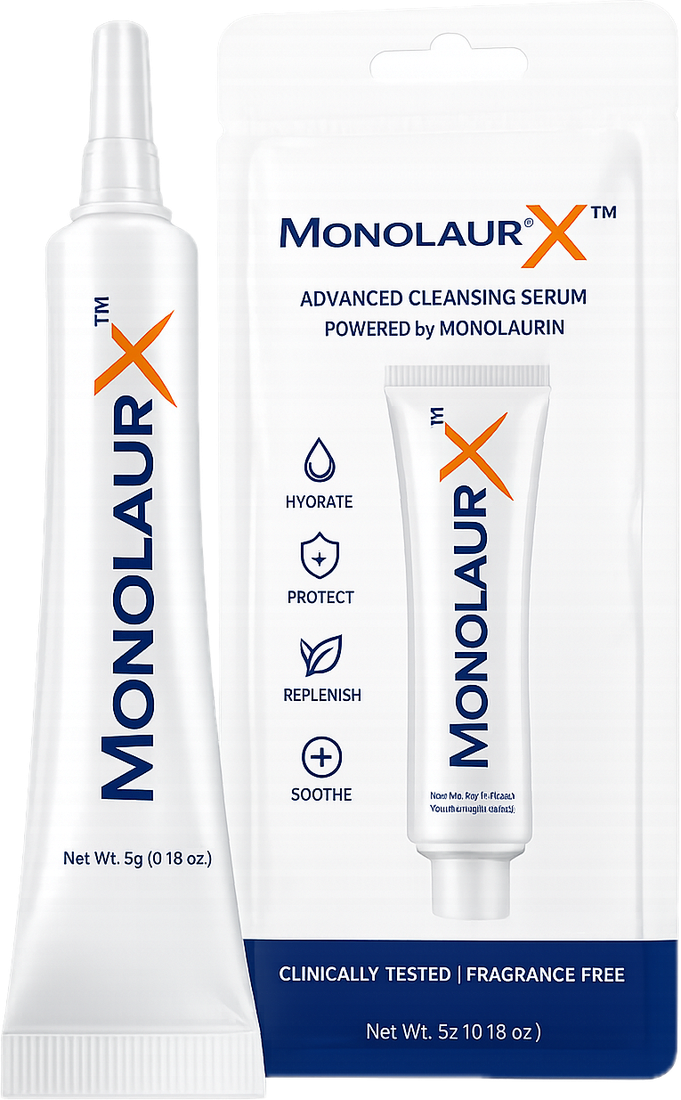
MonolaurX is a cosmetic cleansing serum, not a drug. It is intended for cosmetic cleansing and skin care around cold sores, not medical treatment. Anyone looking for treatment should speak with a qualified healthcare professional and review established cold sore care options.
How People Use Monolaurin Day to Day
People use monolaurin in oral supplements, topical formulations, foods, and cosmetics, but each format has a different purpose and evidence base.
|
Format |
Common Consumer Use |
Evidence Consideration |
|
Capsules |
Oral dietary supplement |
Human clinical evidence remains limited |
|
Pellets or granules |
Oral dietary supplement |
Concentrations and directions vary |
|
Powder |
Oral dietary supplement |
Requires careful measurement |
|
Topical formulation |
Skin or lip care |
Evidence depends on the exact formula |
|
Food or cosmetic ingredient |
Part of a finished product |
Ingredient use does not prove a medical benefit |
Some consumers try oral monolaurin after reading laboratory research or online wellness claims. That research does not support using monolaurin to treat disease. Follow product directions, and discuss medical questions about supplements or dosing with a qualified professional.
Topical GML also appears in cosmetic and skin-care products. MonolaurX is a no-rinse cosmetic cleansing serum for the skin around cold sores. Don't confuse it with another GML formula used in a laboratory study.
Are There Proven Monolaurin and Lysine Benefits?
Research has not established a unique health benefit from combining monolaurin and lysine. Monolaurin is a monoglyceride, while lysine is an essential amino acid. Evidence on either ingredient does not show that combining them produces better results or improves cold sore outcomes. See monolaurin vs lysine for a closer comparison.
Reading the Research Yourself
To evaluate monolaurin research accurately, identify what was studied, how it was used, and whether the subjects were cells, animals, or people.
Check a few basics before accepting a claim:
-
Was the research done in a lab, in animals, or in people?
-
Was monolaurin tested alone or in a finished formula?
-
Was it swallowed, applied topically, or added to a culture?
-
What concentration was tested?
-
What did researchers actually measure?
-
Was there a control group?
-
Were conflicts of interest disclosed?
-
Has another research group repeated the result?
Peer-reviewed studies, PubMed records, ClinicalTrials.gov listings, and government health sources are stronger starting points than testimonials or affiliate content. Claims such as “kills viruses,” “cures infections,” “boosts immunity,” “detoxes the body,” or “works for everyone” deserve extra scrutiny.
Frequently Asked Questions
What are the main monolaurin benefits?
Most proposed monolaurin benefits come from laboratory research, while strong human clinical evidence is still limited.
Is monolaurin proven to boost immunity?
No, current human clinical evidence does not establish monolaurin as an immune booster.
Does monolaurin help with cold sores?
Human studies have not established oral monolaurin as a treatment for cold sores or herpes.
What are the benefits of monolaurin and lysine together?
Research has not shown that combining monolaurin and lysine provides a unique or improved health benefit.
Is topical monolaurin the same as an oral supplement?
No, topical and oral products use different delivery methods, so results from one form cannot be assumed to apply to the other.
Looking for a Practical Next Step?
Monolaurin has produced interesting findings in laboratory and animal research, but most proposed oral benefits remain unproven in controlled human trials. Results from one formula or delivery method cannot be applied to every product containing GML. Checking the study type first makes benefit claims much easier to judge. For more context, read the complete guide to monolaurin and explore the research library when available. For a topical cosmetic option, You can add MonolaurX to a cleansing routine for skin around cold sores.
References
-
Barker, L. A., Bakkum, B. W., & Chapman, C. (2019). The clinical use of monolaurin as a dietary supplement: A review of the literature. Journal of Chiropractic Medicine, 18(4), 305–310. https://doi.org/10.1016/j.jcm.2019.02.004
-
Burnett, C. L., Heldreth, B., Bergfeld, W. F., Belsito, D. V., Hill, R. A., Klaassen, C. D., Liebler, D. C., Marks, J. G., Jr., Shank, R. C., Slaga, T. J., & Snyder, P. W. (2020). Safety assessment of monoglyceryl monoesters as used in cosmetics. International Journal of Toxicology. https://doi.org/10.1177/1091581820966951
-
Mueller, E. A., & Schlievert, P. M. (2015). Non-aqueous glycerol monolaurate gel exhibits antibacterial and anti-biofilm activity against Gram-positive and Gram-negative pathogens. PLOS ONE, 10(3), e0120280. https://doi.org/10.1371/journal.pone.0120280
-
Witcher, K. J., Novick, R. P., & Schlievert, P. M. (1996). Modulation of immune cell proliferation by glycerol monolaurate. Clinical and Diagnostic Laboratory Immunology, 3(1), 10–13. https://doi.org/10.1128/CDLI.3.1.10-13.1996
This article is for general education and is not medical advice. MonolaurX is a cosmetic cleansing serum and is not intended to diagnose, treat, cure, or prevent any disease. Talk with a healthcare professional about symptoms or treatment.