What Is Monolaurin? The Complete Guide
Learn what monolaurin is, where it comes from, how it is made, what researchers study, available formats, and key safety considerations.
MonolaurX Editorial TeamPublished
On this page
Monolaurin is a compound made from glycerol and lauric acid, a fatty acid that makes up nearly 50% of coconut oil. Also known as glycerol monolaurate (GML), monolaurin is used in dietary supplements, food products, cosmetics, and topical formulations.
Interest in monolaurin stems from a growing body of laboratory research on its antimicrobial activity and its potential human applications. The FDA recognizes glycerol monolaurate as generally recognized as safe (GRAS) for use in foods. It is available in several formats, including monolaurin supplements, capsules, powders, and monolaurin pellets. Understanding its origin, formulation, research, common formats, and safety considerations can help clarify how the ingredient is used.
Where Monolaurin Comes From
Monolaurin comes from lauric acid and glycerol, which combine to form a type of compound called a monoglyceride. Lauric acid is a medium-chain fatty acid found in several natural fat sources, with coconut oil among the best-known. Palm kernel oil also contains significant amounts of lauric acid. Lauric acid is also present in human mother’s milk as part of its natural lipid composition, but commercial monolaurin is not extracted from human mother’s milk.
Coconut oil, lauric acid, and concentrated monolaurin are chemically related, but they are not interchangeable. Coconut oil contains a mixture of fatty acids and other components, while monolaurin is a specific compound made from lauric acid and glycerol.
Is Monolaurin Naturally Found in Coconut Oil?
Coconut oil primarily provides lauric acid, not concentrated glycerol monolaurate. A formulated monolaurin product provides glycerol monolaurate directly, so coconut oil should not be considered equivalent to a concentrated monolaurin product in composition, amount, or expected effects.
Is Monolaurin Found in Human Mother’s Milk?
Yes. Human mother’s milk contains lauric acid and other naturally occurring milk lipids, and researchers have identified glycerol monolaurate as a major antimicrobial agent in human mother’s milk, where one study measured it at roughly 3,000 micrograms per milliliter. Human mother’s milk is not a commercial source of monolaurin, which is made by joining lauric acid with glycerol.
How Lauric Acid Becomes Monolaurin
Lauric acid becomes monolaurin when it bonds with glycerol through a chemical process called esterification. In simple terms, esterification joins a fatty acid with an alcohol-containing molecule such as glycerol to create a new compound. Monolaurin is classified as a monoester because it has one lauric acid chain attached to the glycerol structure.
The prefix “mono” refers to that single fatty-acid chain. The compound may appear under several names depending on the scientific, supplement, cosmetic, or ingredient-labeling context. These names generally refer to the same basic compound, although product formulations and purity levels can vary.
Are Lauric Acid and Monolaurin the Same?
No. Lauric acid is a fatty acid, while monolaurin is a compound formed when lauric acid is joined with glycerol. Although lauric acid is used to make monolaurin, the two substances have different chemical structures and should not be used interchangeably when discussing ingredients, supplements, research, or formulations.
What Researchers Have Studied in the Lab
Researchers have studied monolaurin’s effects on microorganisms, including their protective biofilms and their cell membranes, along with topical formulations tested under controlled conditions. Most of this research involves test-tube, cell, or animal studies rather than human clinical trials, so one cannot automatically translate these studies to human benefits. Future research will be needed to document such an association.
What Has Laboratory Research Examined?
Laboratory studies have explored bacterial growth, biofilm formation, membrane interactions, and different GML delivery formats. One 2015 published study tested a 5% GML gel. In laboratory cultures, the gel killed the bacteria tested; in a rabbit surgical-incision model, it inhibited bacterial growth at the incision sites and was associated with less visible inflammation. Other studies have examined how GML interacts with model lipid membranes.
These findings help explain how monolaurin behaves experimentally, but they do not prove the same effects occur in people or across all monolaurin products.
What Are the Limits of the Research?
Laboratory findings do not automatically translate into human clinical outcomes. Experimental concentrations may differ from those used in consumer products, and results from one formula cannot be assigned to every product containing monolaurin.
Research findings in the laboratory do not prove that monolaurin treats, cures, prevents, or shortens cold sores or herpes. Future research is needed to prove that claim. For now, laboratory findings should not be read as proof that monolaurin has the same effect on a cold sore. Our complete monolaurin guide covers the research in more detail.
Frequently Asked Questions
Is monolaurin the same as coconut oil?
No. Coconut oil contains lauric acid and other fatty acids, while monolaurin is a separate compound made from lauric acid and glycerol.
Is monolaurin a fatty acid?
No. Monolaurin is a fatty acid derivative, a monoglyceride formed from lauric acid and glycerol.
Is glycerol monolaurate the same as monolaurin?
Yes. Glycerol monolaurate, or GML, is another name for monolaurin.
Does the body make monolaurin from lauric acid?
The body may convert some lauric acid into monolaurin, but the extent of this conversion in humans is not well established.
How much monolaurin should someone use?
There is no universal monolaurin dosage, so follow the product label and consult a qualified healthcare professional about oral supplement use.
Key Takeaways About Monolaurin
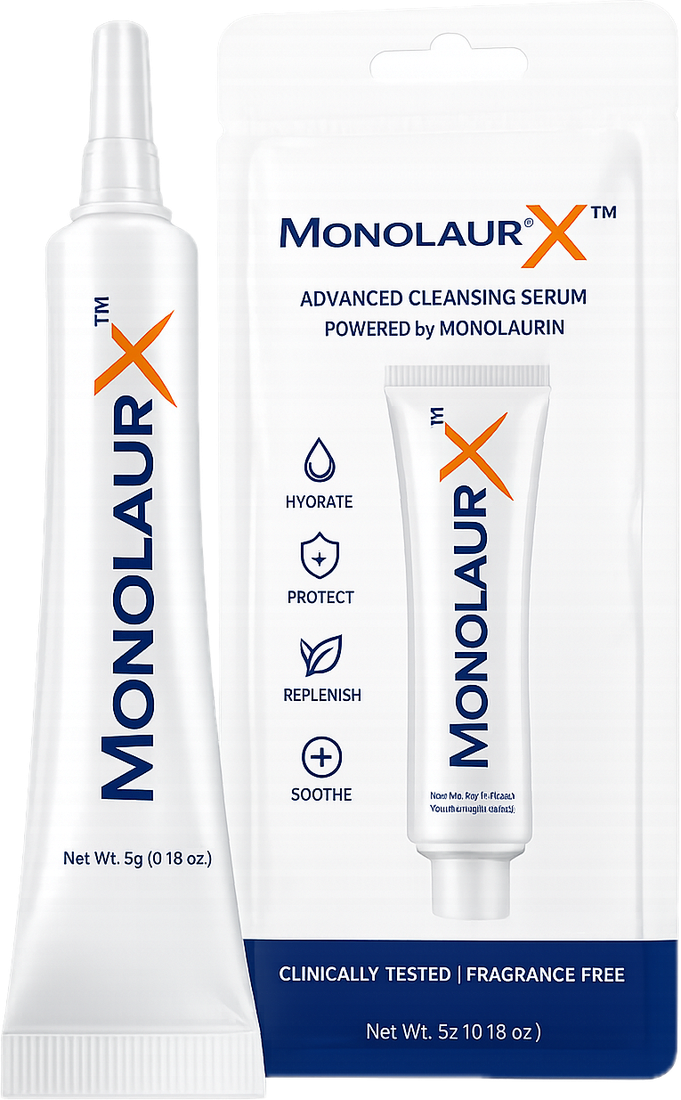
Monolaurin is a monoglyceride formed from glycerol and lauric acid, also known as glycerol monolaurate (GML). Research on the compound covers several settings, but findings depend on the study type, concentration, delivery method, and specific formulation, so laboratory results should not be treated as proof of medical benefit. Learn how MonolaurX works as a topical cosmetic cleansing serum and how its formula is designed to help cleanse around cold sores.
References
- Barker, L. A., Bakkum, B. W., & Chapman, C. (2019). The Clinical Use of Monolaurin as a Dietary Supplement: A Review of the Literature. Journal of chiropractic medicine, 18(4), 305–310. https://doi.org/10.1016/j.jcm.2019.02.004
- Mueller, E. A., & Schlievert, P. M. (2015). Non-aqueous glycerol monolaurate gel exhibits antibacterial and anti-biofilm activity against Gram-positive and Gram-negative pathogens. PloS one, 10(3), e0120280. https://doi.org/10.1371/journal.pone.0120280
- Pereira, C. C., da Silva, M. A., & Langone, M. A. (2004). Enzymatic synthesis of monolaurin. Applied biochemistry and biotechnology, 113-116, 433–445. https://doi.org/10.1385/abab:114:1-3:433
- Thum, C., Wall, C., Day, L., Szeto, I. M. Y., Li, F., Yan, Y., & Barnett, M. P. G. (2022). Changes in Human Milk Fat Globule Composition Throughout Lactation: A Review. Frontiers in nutrition, 9, 835856. https://doi.org/10.3389/fnut.2022.835856
- Schlievert, P. M., Kilgore, S. H., Seo, K. S., & Leung, D. Y. M. (2019). Glycerol monolaurate contributes to the antimicrobial and anti-inflammatory activity of human milk. Scientific Reports, 9, 14550. https://doi.org/10.1038/s41598-019-51130-y
This article is for general education and is not medical advice. MonolaurX is a cosmetic cleansing serum and is not intended to diagnose, treat, cure, or prevent any disease. Talk with a healthcare professional about symptoms or treatment.