Cold Sore Stages: Day by Day, with Photos
MonolaurX Editorial TeamPublished

On this page
Cold sores usually progress through five stages: tingling, blistering, weeping, crusting, and healing. These cold sore stages pertain mostly to Herpes Simplex Virus-1 (HSV-1). Duration and appearance can vary between individuals. Some stages may overlap, and not everyone experiences each one. Photos are used to show common patterns. A cold sore may remain contagious until the skin has fully healed. For more background, see our article on what causes cold sores.
|
Stage |
Approximate period |
Common signs |
|
Tingling |
Day 0–1 |
Tingling, burning, itching, or tenderness |
|
Blistering |
Day 1–2 |
Small fluid-filled blisters |
|
Weeping |
Day 2–3 |
Blisters open and leave a shallow sore |
|
Crusting |
Day 3–7 |
The surface dries and forms a crust |
|
Healing |
Day 7–15 |
The crust lifts and the skin closes |
Note: These ranges are estimates, not a fixed schedule. The American Academy of Dermatology states that most cold sores disappear within 5–15 days in otherwise healthy people.
Stage 1: Tingling (Prodrome)
The prodrome is the warning period before a cold sore becomes visible. You may notice tingling, itching, burning, tenderness, or tightness around the lip while the skin still looks normal or slightly red or swollen. Some people do not notice this stage at all. Mayo Clinic notes that these sensations can begin about a day before a painful spot and blisters appear. A cold sore can be contagious from the first warning symptoms, but tingling alone does not confirm that a cold sore is developing.

Stage 2: Blistering
The blistering stage typically involves one or more small, fluid-filled blisters that may appear alone or in a cluster, often along the lip border or nearby skin. The area can also become red, swollen, painful, or tender. Avoid popping or picking the blisters, which can irritate the skin and increase the chance of spreading fluid to other areas. Cold sores usually form grouped blisters outside or around the lips, while pimples often contain pus and canker sores generally develop inside the mouth. If you are unsure what a lesion is, a healthcare professional can assess it.

Stage 3: Weeping
The weeping stage begins when the blisters break, leaving a moist, shallow open sore that may ooze before it starts to dry. Direct spread is a particular concern when the blister is open, so wash your hands after touching the area and keep hygiene gentle. Avoid picking, squeezing, or pulling away loose skin, and do not apply harsh substances such as alcohol, hydrogen peroxide, household disinfectants, or undiluted essential oils. A cold-sore-specific patch can help protect the area when used according to its directions, but covering the sore does not make it noncontagious. See our guide to cold sore patches.

Stage 4: Crusting
As the open sore dries, it forms a crust or scab that may appear yellow, brown, red, or darker depending on skin tone and lighting. This stage can feel tight, itchy, dry, or uncomfortable, and normal movements such as eating or speaking may cause the crust to crack. Let it loosen and come away naturally rather than picking it off. A crusted cold sore can still be contagious until the skin has completely healed. Seek medical advice if symptoms become unusually severe or the area develops increasing redness, swelling, drainage that looks like pus, or worsening pain.

Stage 5: Healing
During the healing stage, the crust loosens naturally as the skin closes underneath. Some redness or temporary discoloration may remain, and the new skin can feel dry, sensitive, or tight for a short time. Most cold sores heal without scarring, so avoid pulling off any remaining crust before it is ready. HSV stays in the body after the visible sore is gone, which is why cold sores can return. Full healing means the skin is closed with no wet, open, or scabbed area left.

How Long Does Each Stage Last?
A complete cold sore outbreak often lasts about 5–15 days, but the timing is only an estimate. It can last longer in immunocompromised individuals. The stages can overlap, and some people never notice every phase. First outbreaks may be more severe or last longer, while recurrent outbreaks are often smaller or milder. Picking, friction, irritation, or a secondary infection can also slow healing. The American Academy of Dermatology notes that most cold sores clear within 5–15 days in otherwise healthy people, while the NHS advises seeking help if a cold sore has not started healing within 10 days.
When Should You See a Healthcare Professional?
Most cold sores heal on their own, but some situations deserve medical advice:
-
The sore has not started healing within 10 days or lasts longer than two weeks.
-
It is unusually large, painful, spreading, or close to an eye.
-
You have frequent outbreaks, eczema, or a weakened immune system.
-
The area shows signs of infection, such as increasing redness, swelling, pus, or worsening pain.
-
You are not sure whether the lesion is a cold sore.
Caring for Your Lips at Every Stage
Simple hygiene and gentle care can help protect the affected area and reduce the chance of spreading HSV:
-
Wash your hands before and after touching the area.
-
Do not pop, pick, or peel the sore.
-
Avoid kissing and oral contact until the skin has fully healed.
-
Do not share lip products, cups, utensils, towels, or razors.
-
Avoid touching your eyes after touching the sore.
-
Keep products and applicators clean.
-
Follow the directions for any over-the-counter or prescription treatment.
-
Antiviral treatment is generally most useful when started early, but follow advice from a healthcare professional or the product label.
-
Use extra caution around newborns and people with weakened immune systems.
Where Does MonolaurX Fit?
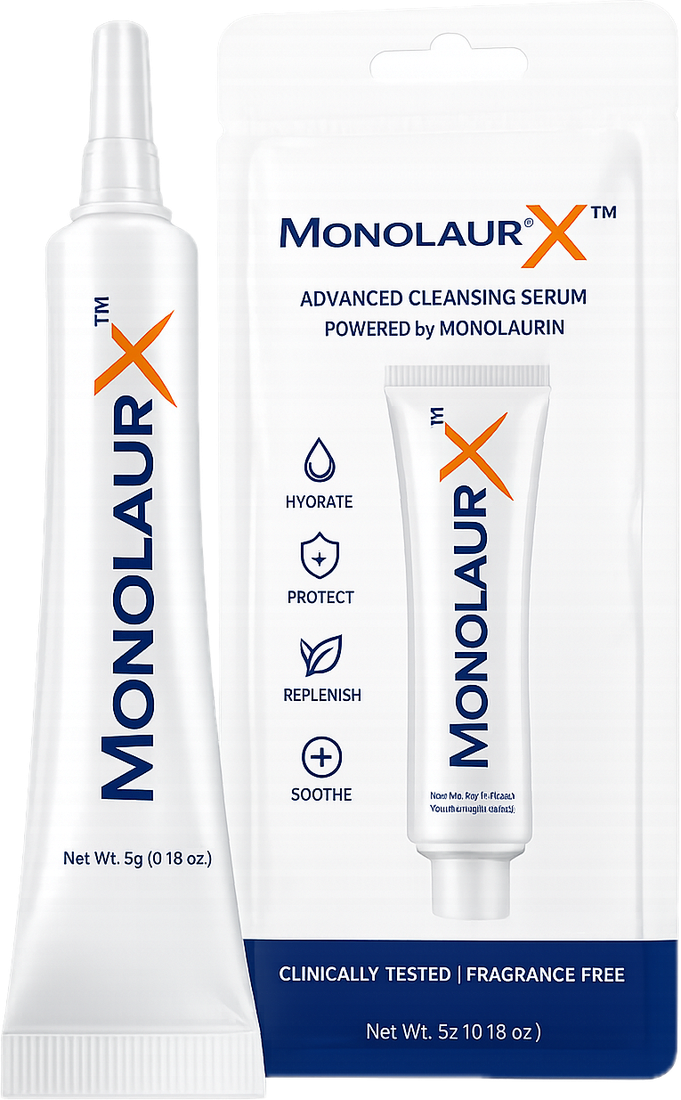
MonolaurX is a no-rinse cosmetic cleansing serum designed to help cleanse the skin around cold sores and support stressed lips. It is cosmetic lip care, not a drug, and it does not treat or cure cold sores. It should not be used as a replacement for antiviral treatment or medical care when those are appropriate.
Frequently Asked Questions
How many stages does a cold sore have?
Cold sores commonly progress through five stages: tingling, blistering, weeping, crusting, and healing.
How long does a cold sore usually last?
Most cold sores clear within about 5–15 days, although healing time can vary from person to person.
What does a cold sore look like in the early stage?
Early signs may include tingling, burning, itching, mild redness, or swelling before blisters appear.
Is a cold sore still contagious when it has a scab?
Yes, a cold sore may remain contagious until the skin has fully healed and no open or scabbed area remains.
How do I know when a cold sore is fully healed?
A cold sore is considered fully healed when the skin is closed and there is no wet, open, or crusted area left.
Support Your Lips Through Every Stage
Cold sores commonly move through tingling, blistering, weeping, crusting, and healing, but the timing and appearance can vary from person to person. The area may remain contagious until the skin has fully healed, and photos alone cannot confirm a diagnosis.
If you want a simple cosmetic cleansing step for the skin around a cold sore, you can also try MonolaurX as part of your lip-care routine. It is designed for cleansing and stressed-lip support, not as a treatment for HSV or cold sores.
References
-
Gilbert, S., Corey, L., Cunningham, A., Malkin, J. E., Stanberry, L., Whitley, R., & Spruance, S. (2007). An update on short-course intermittent and prevention therapies for herpes labialis. Herpes : the journal of the IHMF, 14 Suppl 1, 13A–18A. https://pubmed.ncbi.nlm.nih.gov/17877887/
-
Leung, A. K. C., & Barankin, B. (2017). Herpes Labialis: An Update. Recent patents on inflammation & allergy drug discovery, 11(2), 107–113. https://doi.org/10.2174/1872213X11666171003151717
-
National Health Service. (n.d.). Cold sores. NHS. https://www.nhs.uk/conditions/cold-sores/
This article is for general education and is not medical advice. MonolaurX is a cosmetic cleansing serum and is not intended to diagnose, treat, cure, or prevent any disease. Talk with a healthcare professional about symptoms or treatment.